You're writing the invitation and you reach the line that says "from 2:00 to...?" Too short, and the cake barely reaches the table. Too long, and by hour three the sugar, the noise and the tired little legs are running the show.
So, how long should a kids birthday party last? For most families, about two hours is the sweet spot. Age moves that number up or down, and so does what you plan to do with the time. Below you'll find the ideal party length for each age, two sample timelines and the signs that it's time to wrap up. We've run hundreds of parties for kids from 3 to 12, so the timings here come from what actually works in a room full of kids, backed by pediatric and child-development sources.
Quick answer: Toddlers (1–3) do best with 60 to 90 minutes or less. Ages 4–5 do well with 90 minutes to 2 hours. Ages 6–8 can go 2 to 2.5 hours, and ages 9–12 can stretch to 3. That is total party time, and the entertainer's program usually takes 60 to 90 minutes of it.
Birthday Party Length by Age: Quick Reference
Treat these as ranges, not rules, because kids are not clocks.
|
Age |
Ideal total length |
Entertainment portion |
|
1–3 |
60–90 minutes or less |
30–45 min of simple play |
|
4–5 |
90 minutes–2 hours |
60–75 min |
|
6–8 |
2–2.5 hours |
60–90 min |
|
9–12 |
2–3 hours |
90 min |
These ranges line up with mainstream parenting guidance. The American Academy of Pediatrics' parenting site, HealthyChildren.org, advises keeping parties for young children short and simple, and PBS Kids for Parents suggests roughly 90 minutes at age 3, about two hours at ages 4 and 5, and no more than two and a half hours at ages 6 to 8.
One thing most guides skip: party length includes everything. Arrival, the program, food and cake, photos and goodbyes all count. If you book a 60-minute show, you don't have a 60-minute party. You have a roughly two-hour party with a one-hour show in the middle.
What Decides the Right Party Length
Age is the starting point. Four other things fine-tune it.
Attention span. Understood notes that age isn't the only factor in how long a child can focus. Things like sleep, breakfast and stress can also affect attention. In party terms, a program with a clear "next thing" keeps kids engaged far longer than open-ended free play.
Sleep and nap time. The American Academy of Sleep Medicine recommends about 11 to 14 hours of sleep a day for toddlers, 10 to 13 for preschoolers and 9 to 12 for school-age kids (see the Sleep Foundation's guide). Most children stop napping regularly around age 4, but many younger ones still do. Build the start time around nap time, and for evening parties, end early enough that bedtime doesn't suffer.
Guest count. A common pediatric rule of thumb for young kids is to invite about one guest per year of age, plus one: roughly four kids for a 3-year-old and five for a 4-year-old. Big crowds overwhelm little ones, and an overwhelmed child doesn't want to stay for three hours.
Structure. Plan roughly 10 to 15 minutes per game or activity and let a favorite run longer. Five to seven activities fill 60 to 90 minutes without anyone getting restless.
How Long Should a Birthday Party Last for Each Age?
Ages 1–3: Short and sweet
For one-year-olds, aim for under an hour to protect nap schedules. Two-year-olds mostly play beside each other rather than together, so skip organized games and offer a few simple stations instead. Three-year-olds enjoy singing and circle activities and can manage about 90 minutes. At these ages, the guest of honor is usually happiest when the party ends a little before they're done.
How long should a 4-year-old's birthday party last?
Aim for 90 minutes to 2 hours in total, with roughly an hour of actual activity. Four-year-olds love short, fast-moving games, music and a treasure or scavenger hunt, and they lose steam when anything drags. Keep the guest list small (about five kids) and check the nap question: some four-year-olds have dropped it, some haven't, and a cranky cake moment is hard to recover from.
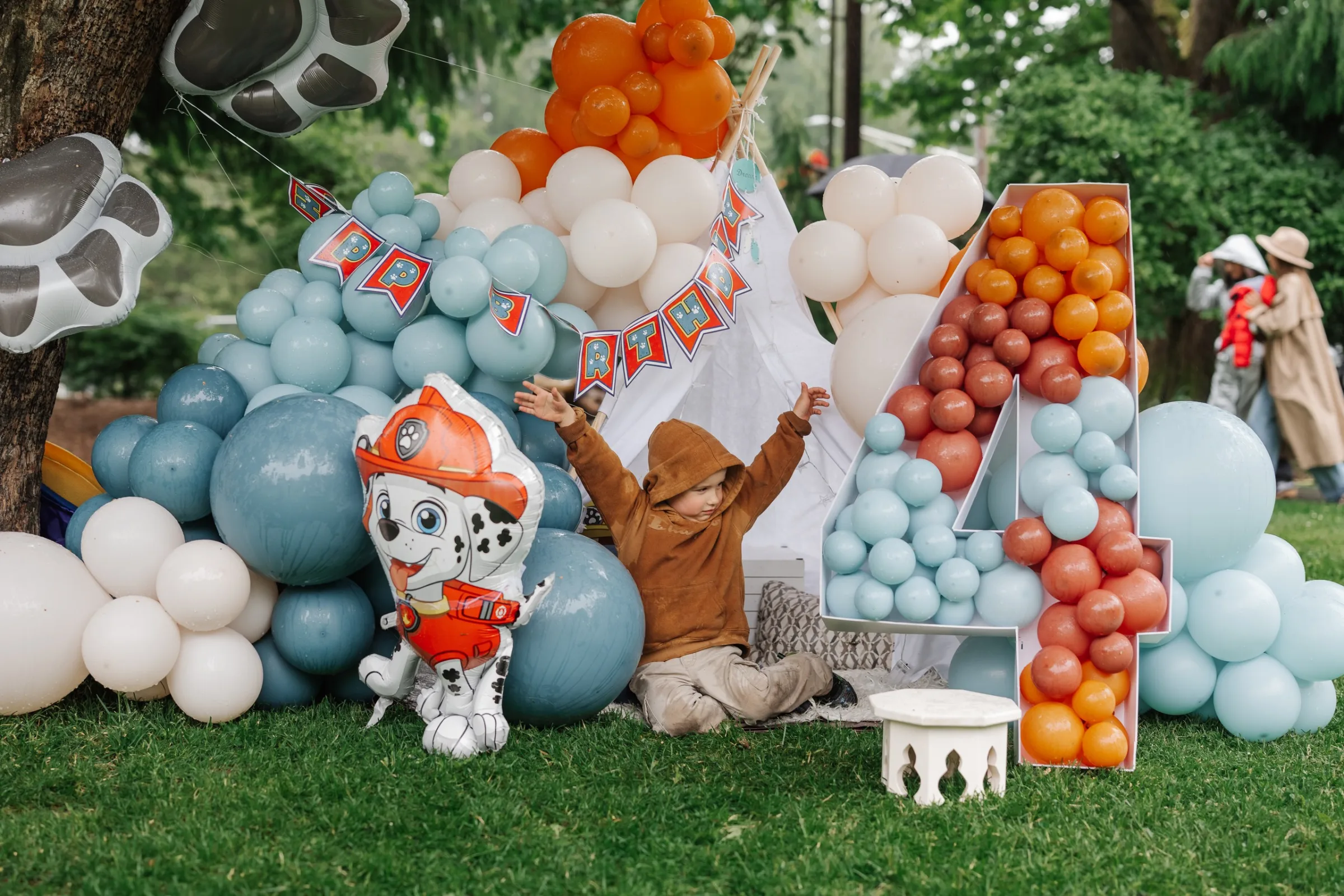
A fit from our side: Paw Patrol Rescue (ages 3–6, 60 to 90 minutes) is built for this attention span, and our Princess Party works from age 3 to 10.
How long should a 5-year-old's birthday party last?
About two hours. Five-year-olds are ready for a theme and love dramatic play, dress-up and simple crafts. They also like having a say, so let your birthday kid choose the theme. A theme does a lot of work at this age: it gives every activity a reason to exist, which keeps the group together without constant herding.
A fit from our side: Frozen Queen (ages 3–9) and Mermaid Show (ages 5–12) each combine a story, games, dancing and a craft in one 60 to 90 minute program.
How long should a 6-year-old's birthday party last?
Two to two and a half hours is the ceiling. Six-year-olds enjoy organized games with rules, and clue-based or mystery games go over well. Friendship takes center stage around now: the CDC's positive parenting tips for ages 6–8 note that friendships become more and more important, along with a growing interest in teamwork. Team challenges and group missions work better than games where one child wins and everyone else waits.
A fit from our side: Superhero Academy and Space Party (both ages 5–9) are missions with a team finale, so every child is part of the story.
How long should a 7-year-old's birthday party last?
The same two to two and a half hours, with a different flavor. By seven, kids want more choice and independence, so let them help shape the plan. Hands-on formats work well: a make-and-take workshop where kids create something to bring home, a science show or a quest with clues.
A fit from our side: the Make & Take Workshop (slime, cookie decorating, fashion patches and more), the Science & Cryo Show and Sonic Adventures (ages 5–10) all fit comfortably into an hour plus cake.
Ages 8–9: Keep the pace up
Two to two and a half hours still works, and by nine many kids can handle closer to three if the program is active. Offer choices (which challenge, which craft, which team) and avoid long stretches of sitting.
How long should a 10-year-old's birthday party last?
Plan for two to three hours. That fits the typical school-age range, and it's also the length of a standard three-hour room rental. Friendships matter a great deal at this age. The CDC's tips for ages 9–11 call healthy friendships very important to development and note that kids this age need about an hour of physical activity a day and 9 to 12 hours of sleep. In practice: give them something active, give them a say and set a clear end time so nobody is up until midnight.
The biggest format risk at ten is anything that feels "babyish." Go for energy and choice: a K-pop dance party where kids learn and perform a signature routine, a Power-Up party with races and challenges, or a workshop where they make something they'd actually keep. Both programs run 60 to 90 minutes (K-pop for ages 6–12, Power-Up for ages 5–12).
Ages 11–12
The same logic holds: finish within about three hours, keep it active and let the birthday kid and a friend or two help choose the plan.
Two Sample Birthday Party Timelines
A 2-hour party (ages 4–7)
-
0:00–0:15: Arrival and a simple welcome activity
-
0:15–1:30: Entertainment program
-
1:30–1:50: Cake and snacks
-
1:50–2:00: Photos, goodie bags, goodbyes
A 3-hour party (ages 9–12, or a rented room)
-
0:00–0:20: Arrival and free play
-
0:20–1:50: Entertainment program
-
1:50–2:30: Food and cake
-
2:30–3:00: Gifts, photos, pickup
Two small things make a big difference. First, put both the start and end time on the invitation so other parents can plan their day. Second, if you're renting a space, check that setup and cleanup fit inside the time you're paying for.
Signs Your Party Is Running Too Long
You'll usually see it before you hear it: kids drift away from the activity, small disagreements turn into big ones, the birthday child goes quiet or starts to unravel, and parents glance at their phones. If you notice two or three of these at once, move to cake and goodbyes.
A good rule of thumb is to end while the kids still want one more game. A party that finishes on a high note is the one they talk about on the drive home.
How Wonder Spark Fits the Clock
Most Wonder Spark programs run 60 to 90 minutes, which is the middle of a two-hour party: program, then cake, then photos. You don't have to run the games, manage the music or keep the energy up, so you actually get to enjoy the party.
A few examples: character programs start from $350 for a 60-minute show with one character. Spa parties and Science & Cryo Shows start at $400 for 60 minutes, and Make & Take Workshops start at $450. If you'd like a space of your own, our party room rental gives you a private three-hour window for up to 45 guests, with a soft play corner for little ones and tea, tableware, tables and chairs included, from $400.
Planning for Seattle's wetter months? Our guide to indoor birthday party ideas for rainy Seattle days pairs well with this one.
Ready to pick a date? Book a party, browse our programs or call. Tell us your child's age and your date, and we'll help you plan the right length.
FAQ
How long should a kids birthday party last if the guests are different ages?
Plan around the youngest guests and choose a program that works for the whole group. Aim for the two-hour range, since it's comfortable for both preschoolers and early school-age kids.
Is two hours too short for a birthday party?
For most kids under 9, no. Two hours gives you time for arrival, a program, cake and goodbyes without anyone running out of steam.
Should I put an end time on the invitation?
Yes. A clear start and end time helps other parents plan their day and makes it much easier to wrap up on schedule.
How long should the entertainment part be?
Usually 60 to 90 minutes. That's enough for five to seven activities and still leaves time for cake and photos.
Does cake time count toward the party length?
Yes. Count arrival, the program, food, cake, photos and goodbyes as part of the total.